Resource Center / Building Science
How Failing HVAC Plenum Tape Can Lead to Mold Contamination Throughout a Home
Many homeowners assume mold problems start with an obvious leak. In reality, one of the most overlooked sources of hidden contamination is mechanical, not water-related at all: the tape sealing an HVAC plenum. When that tape's adhesive fails, it can open a direct pathway for dust, fiberglass particles, and mold spores to enter the air handler and travel through a home's entire duct system, often with no visible sign until a musty odor or vent staining finally appears.
What Is HVAC Plenum Tape, and Why Does It Fail?
The plenum is the central chamber connected directly to an air handler where conditioned air is gathered before being routed into the branch ductwork that supplies individual rooms. Because the plenum is typically assembled from separate metal or fiberboard panels, the seams and duct connections around it are sealed with a specialized tape designed to keep the system airtight.
That tape is not intended to last indefinitely. Its performance depends entirely on an adhesive bond, and adhesive bonds are consumable: they degrade with exposure to heat, humidity, and time. In a Florida attic or garage, where temperatures regularly climb well above what the tape's adhesive was originally designed to tolerate over the long term, that degradation can accelerate considerably compared to a more climate-controlled installation location.
As the adhesive ages, it gradually loses its grip and begins to separate from the metal or fiberboard surface it was applied to. The normal vibration and thermal expansion and contraction that occur every time the HVAC system cycles on and off place ongoing physical stress on that weakening bond, which is why plenum tape failure tends to be a slow, cumulative process rather than a sudden event.
How Negative Pressure Draws Contaminants Through a Failed Seal
An air handler works by pulling air through the system to be filtered, conditioned, and redistributed. That process creates a zone of negative pressure inside the cabinet and the ductwork connected to it. Under normal conditions, with an intact, properly sealed plenum, that negative pressure simply pulls return air through the filter and evaporator coil, exactly as the system is designed to do.
Once the plenum tape's adhesive fails and a gap opens at a seam or duct connection, that same negative pressure no longer discriminates between the air it is supposed to pull through the filter and the air immediately surrounding the gap. Whatever is in that surrounding air, whether it is ordinary dust, airborne fiberglass insulation particles, elevated humidity, or mold spores, gets drawn directly into the airstream and bypasses the filtration the system was designed to rely on.
Because the air handler sits at the center of the entire duct network, contaminants pulled in through a single failed seam do not stay isolated. Every time the system runs, that same air handler distributes conditioned air, and anything mixed into it, out through the supply ductwork to every room the system serves. A single localized seal failure can therefore become a whole-house indoor air quality issue over a surprisingly short period of continuous operation.
Why Garage-Located Air Handlers Are a Particular Risk Factor in Florida
Many Florida homes place the air handler in the attached garage rather than a conditioned interior closet or attic space. This is a common and generally acceptable installation practice, but it comes with a specific vulnerability: an attached garage is not conditioned living space, and its air quality is subject to significant heat and humidity swings, vehicle exhaust residue, stored chemicals, dust from stored materials, and airborne fiberglass from insulation or building materials.
When a plenum seal on a garage-located air handler is intact, none of that matters much, because the system draws its return air from the conditioned interior of the home rather than the garage itself. The moment a seal fails, however, the air handler is sitting directly inside an environment well-suited to introducing exactly the kind of contamination a failed seal allows in: elevated ambient humidity, airborne dust, and, if any organic material nearby has been exposed to moisture, mold spores.
- Elevated ambient temperature. Florida garages routinely reach temperatures well above interior comfort levels, accelerating adhesive breakdown on any tape or sealant nearby.
- Elevated humidity. Garages are typically unconditioned and can trap humid air, especially with limited ventilation, creating conditions favorable to microbial growth on any surface where dust and moisture accumulate together.
- Airborne particulates. Dust, fiberglass insulation particles, and other contaminants common to a garage environment are readily available to be drawn into any gap that develops in the plenum or duct seals.
- Limited visibility. Because homeowners rarely inspect the back or top of an air handler cabinet closely, a slowly developing seal failure in a garage installation can go unnoticed far longer than a more visible household problem.
None of this means a garage-located air handler is inherently problematic. It does mean that periodic inspection of the plenum seals and tape condition is particularly worthwhile for homes with this configuration, since the consequences of a failed seal are compounded by the surrounding environment.
Signs to Watch For
Because the plenum and the interior of the ductwork are not visible during normal use, most homeowners only become aware of a problem once its effects show up elsewhere in the home. A persistent musty odor that does not resolve with normal cleaning is one of the most common indicators, particularly when it seems to be present throughout multiple rooms rather than confined to one area.
Visible discoloration around supply vents or registers is another meaningful sign. As contaminated air passes through the vent opening repeatedly, it can leave staining on the surrounding ceiling or wall surface over time. Recurring dust accumulation that returns quickly despite regular filter changes is also worth taking seriously, since it suggests the source of the dust is inside the system itself rather than the room being tracked in from outside.
None of these signs on their own confirms a plenum seal failure, but taken together, and especially in a home with a garage-located air handler, they are a reasonable basis for requesting a professional HVAC mold inspection rather than continuing to rely on filter changes alone.
Common Warning Signs
- • Persistent musty odor throughout multiple rooms
- • Visible discoloration around supply vents or registers
- • Dust that reaccumulates quickly after filter changes
- • Air handler located in an attached garage
- • Aging or original HVAC tape that has never been inspected
Case in Point: A Weston, Florida Residence With a Garage-Located Air Handler
Location
Weston, Florida residence
Reported Concern
Persistent musty odor and discolored supply vents, with recurring dust despite regular filter changes
System Location
Air handling unit located in the attached garage
Root Cause Identified
Deteriorated plenum tape adhesive with separated seals
Home Enviro documented exactly this mechanism during a residential HVAC mold inspection in Weston, Florida. The homeowner had noticed musty odors and discoloration around several supply vents, along with dust that kept returning despite regular filter changes, all while the air handler sat in the attached garage. A full inspection, including thermal imaging, moisture measurements, and direct examination of the air handler, plenum, and accessible duct connections, found that the plenum tape's adhesive had deteriorated significantly, opening gaps that allowed contaminated garage air, dust, fiberglass particles, and fungal spores into the system.
Visible microbial growth was found on portions of the HVAC cabinet and plenum assembly, and evidence of contamination extended into sections of the duct system serving multiple rooms in the home. Although the garage itself was never conditioned living space, the compromised plenum had become the pathway through which its air reached the rest of the house.
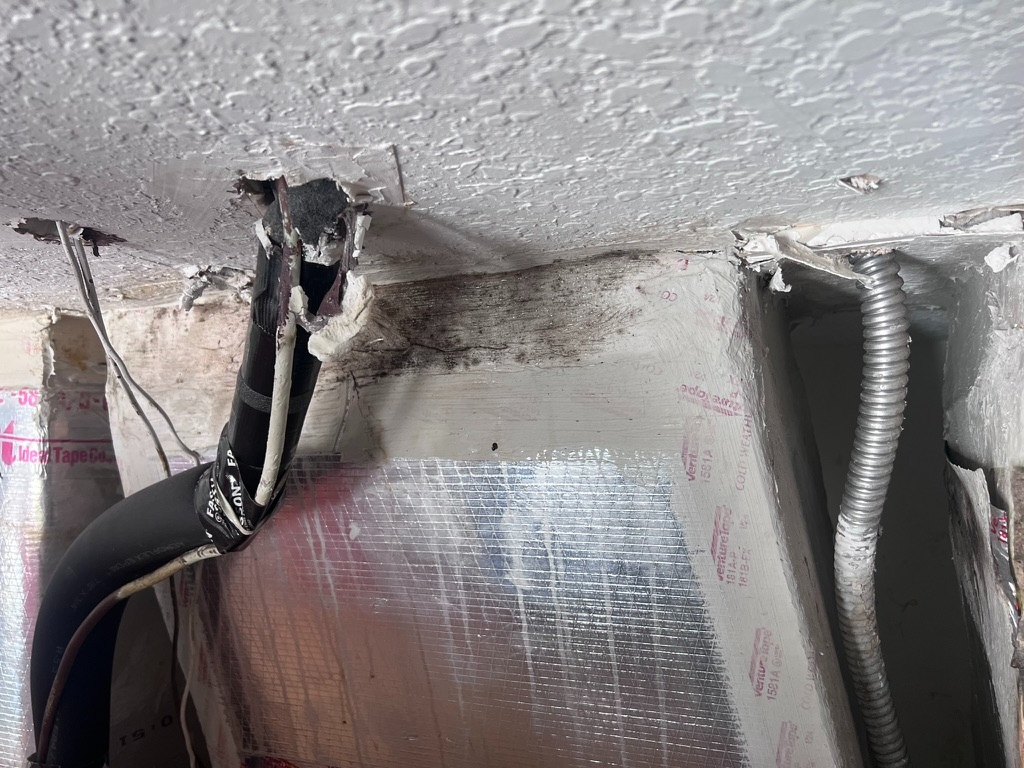
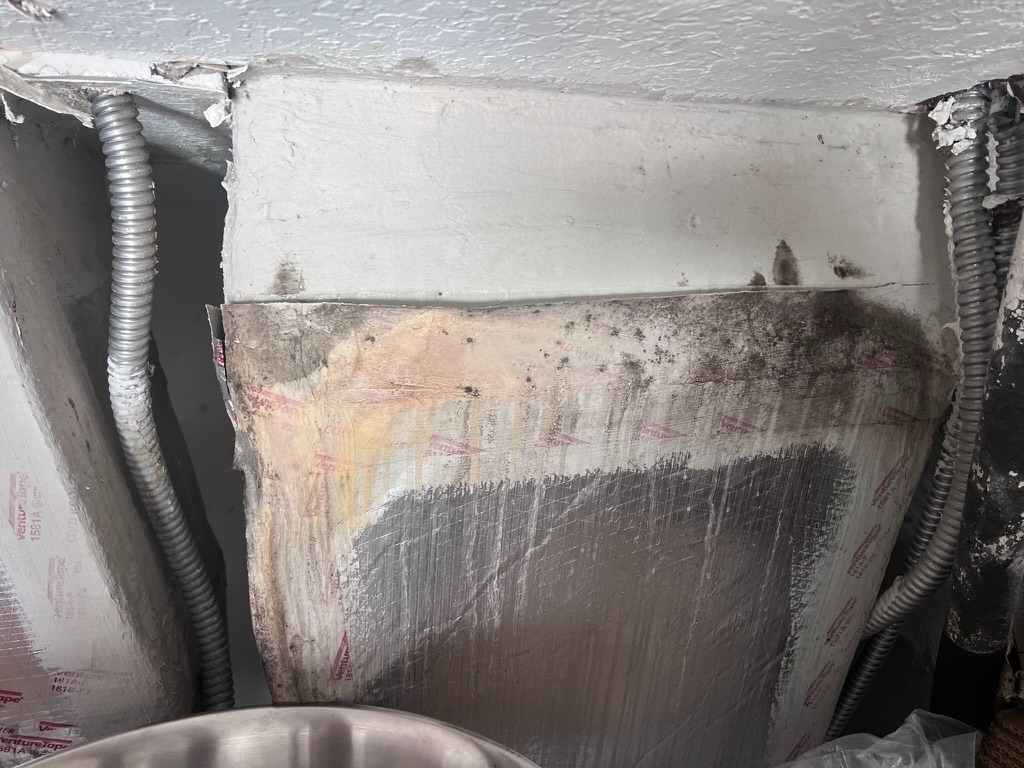
The full findings, methodology, and recommendations from this investigation are documented in the full inspection case study, which walks through the inspection process in detail and includes additional photographs from the field.
What to Do If You Suspect a Plenum Seal Problem
Confirming a plenum tape failure and any resulting contamination requires more than a quick look at the air handler. A proper HVAC mold inspection should include a visual examination of the HVAC system and ductwork, moisture measurements, thermal imaging, direct inspection of the air handler, plenum, and accessible duct connections, and mold sampling where appropriate to support the visual findings.
If an inspection confirms deteriorated tape, failed seals, or contamination inside the system, the recommended corrective path generally involves removing and replacing all deteriorated HVAC tape and failed plenum seals, properly resealing all plenum and duct connections using approved HVAC sealing materials, professional cleaning of the affected system and ductwork, and HEPA vacuuming of the air handler cabinet and accessible mechanical components. Any moisture conditions contributing to the growth should also be corrected, HVAC filters should be replaced following the cleaning, and a post-remediation verification inspection should confirm the corrective work was effective.
This corrective work should be performed by a qualified HVAC contractor. An independent inspection firm's role is to identify the condition, document the extent of contamination, and verify the results of the repair, keeping the findings free of any conflict of interest with the party performing the physical work.
HVAC Plenum Tape & Mold FAQ
Plenum tape relies on an adhesive bond to hold it against the metal surfaces of the air handler cabinet and duct connections. That bond is a consumable component, not a permanent one. Age, elevated temperatures common in garages and attics, humidity, and the constant operation of the HVAC system all contribute to the adhesive gradually breaking down and separating from the metal it was applied to.
An air handler creates negative pressure inside its cabinet and connected ductwork as it pulls air through the system to be conditioned. When a plenum or duct seal has failed and a gap exists, that negative pressure actively draws in whatever air is available immediately outside the gap, along with anything suspended in it, including dust, fiberglass insulation particles, mold spores, and other contaminants.
Attached garages are rarely conditioned space, and Florida's climate subjects them to significant heat and humidity swings throughout the year. Garages can also collect airborne dust, fiberglass particles, and other contaminants from stored materials or building components. When an air handler located in the garage develops a failed seal, it sits directly in an environment well-suited to introducing exactly the kind of contamination that a compromised seal allows into the system.
Common indicators include a persistent musty odor throughout the home, visible discoloration around supply vents or registers, and recurring dust accumulation that returns despite regular filter changes. Because the plenum and duct interior are not visible during normal use, these symptoms are often the only outward clue that something is wrong inside the mechanical system.
Yes. Unlike many mold problems that originate with a plumbing or roof leak, a failed plenum seal introduces contamination through airflow and humidity rather than direct water intrusion. Garage air, dust, and fungal spores can be drawn into the air handler and distributed through the duct system purely as a result of the pressure dynamics created during normal HVAC operation.
Related Building Science Topics
If You Suspect HVAC Mold Contamination
Need a Licensed Independent HVAC Mold Inspection?
If you suspect deteriorated plenum tape, contaminated ductwork, or mold in your air handler, schedule an independent inspection with Home Enviro.
Schedule Your HVAC Mold Inspection